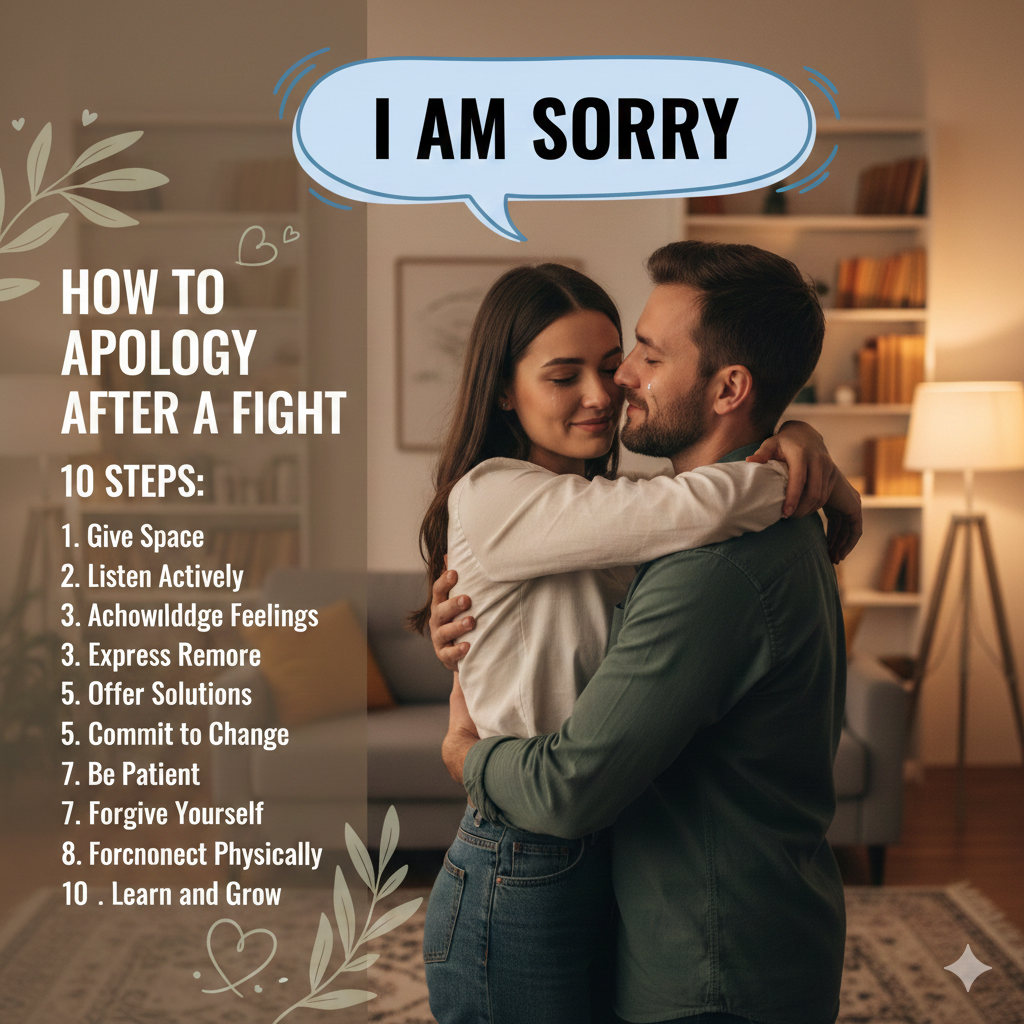

Learning how to apologize after a fight can save your relationship. Discover proven apology techniques, emotional repair strategies, conflict resolution tips and trust-building methods for couples who want deeper connection and long-lasting love.
Introduction: Let’s Be Real — Apologizing Is a Whole Skill 🎭❤️
If apologizing after an argument were easy, half of us wouldn’t be pacing around the house rehearsing lines like we’re in some Netflix drama. 😭
You ever finish a fight and suddenly you’re lying in bed staring at the ceiling like, “Sigh… I really shouldn’t have said that.” Or worse—scrolling through TikTok waiting for the courage to text first? 😂
But whether the disagreement was small (“Why you left the dishes?”) or big (“So… who is THAT texting you at 11 pm?”), knowing how to apologize after a fight is one of the most important relationship skills you can ever learn.
A proper apology has the power to:
- Melt tension
- Rebuild emotional closeness
- Restore safety
- Strengthen trust instantly
- And remind your partner that the relationship is bigger than the conflict
This guide breaks down the 10-step roadmap to apologize effectively, rebuild trust, and reconnect in a loving, healthy way. It’s warm, honest, real, and packed with practical steps you can use TODAY.
If you want to learn how to rebuild trust after a fight, communicate better, and become a more emotionally intelligent partner—this one is for you. 💞✨
The 10-Step Roadmap: How to Apologize After a Fight & Rebuild Trust Instantly
1. Take a Moment to Calm Down 😌 (Essential for a Healthy Apology)
Before you reach out you need to calm the emotional volcano inside you. That first moment after a fight carries the energy of the entire apology which is exactly why rushing to apologize after a fight before you’re ready often makes things worse instead of better.
When you’re upset your brain reacts emotionally not logically. By giving yourself a few minutes or even a few hours you prevent saying something you’ll regret again. This is the foundation of healthy conflict resolution and one of the most overlooked parts of learning how to apologize after a fight properly.
Taking space to calm down prevents another argument, makes you think clearer, shows emotional maturity and allows you to communicate calmly and respectfully when it matters most. Knowing how to apologize after a fight is one of the most valuable relationship skills anyone can develop.
Why this matters:
- It prevents another argument
- It makes you think clearer
- It shows emotional maturity
- It allows you to communicate calmly and respectfully
Pro Tip:
When you’re upset, your brain reacts emotionally, not logically. By giving yourself a few minutes (or hours), you prevent saying something you’ll regret again. The first and most important step when you want to apologize after a fight is giving yourself enough time to calm down before reaching out.
This is the foundation of conflict resolution and a powerful part of learning how to communicate in relationships.
2. Reflect on the Situation Honestly 🧠💭 (Accountability Builds Trust)
Before you apologize after a fight take time to reflect on what triggered the argument, what you said or did that may have hurt them, whether you misunderstood something and how your tone or behavior contributed to the conflict.
Self-awareness is the heart of emotional growth and one of the most powerful tools for knowing how to apologize after a fight in a way that actually lands. It helps you apologize sincerely and avoid repeating the same mistakes over and over again. Taking time to reflect before you apologize after a fight is what separates a genuine apology from an empty one.
One disagreement that sticks with me happened after a long day when my girlfriend and I both misunderstood each other’s messages. I assumed she was upset with me and instead of asking what was wrong I became distant. Later I realized I had overreacted. I called her, apologized for letting my emotions take over and admitted that I should have communicated instead of making assumptions. That conversation reminded me that misunderstandings can grow quickly if you don’t address them with honesty.
Before apologizing, take time to reflect on:
- What triggered the argument
- What you said or did that may have hurt them
- Whether you misunderstood something
- How your tone or behavior contributed to the fight
Self-awareness is the heart of emotional growth. It helps you apologize sincerely and avoid repeating the same mistakes. According to Verywell Mind, self-reflection before an apology significantly increases the chance of genuine reconciliation between partners.
Couples who reflect instead of react create deeper, safer, more understanding relationships.
3. Reach Out with Warm Energy, Not Attitude 📱✨ (Tone Matters!)
When you’re ready, reach out gently. No shade. No passive-aggressive “You good?” messages. 😅
When you’re ready to apologize after a fight reach out gently. No shade. No passive-aggressive “You good?” messages 😅. This is a soft start-up a technique used in healthy communication and emotional repair that sets the tone for the entire conversation. The way you reach out sets the entire tone for how to apologize after a fight successfully.
Try lines like:
- “Hey babe, when you’re ready, I’d really like to talk.”
- “I care about us and I don’t want this distance between us.”
- “Let’s talk when you’re ready. I’m here.”
These kinds of openers show maturity, respect and a genuine intention to fix things between you.
This is a soft start-up—a technique used in healthy communication and emotional repair.
It shows maturity, respect and intention to fix things.
4. Start with a Clear, Genuine Apology ❤️ (No Half Apologies Allowed)
A proper apology after a fight includes four elements — acknowledging what happened, taking responsibility, expressing remorse and showing love and accountability. All four matter and leaving any of them out weakens the apology significantly.
Something that always helps me when I apologize after a fight is telling her exactly what I’m sorry for instead of giving a generic apology. I’ll say something like “I’m sorry for raising my voice. I know that hurt you and you didn’t deserve that.” Being specific shows you actually paid attention to what happened and that your apology is genuine rather than just an attempt to end the tension quickly. A clear and genuine apology is the heart of knowing how to apologize after a fight in a way that actually heals the relationship.
A proper apology includes four elements:
- Acknowledge what happened
- Take responsibility
- Express remorse
- Show love and accountability
Example:
“I’m really sorry for how I spoke to you earlier. I shouldn’t have raised my voice and I see how that hurt you.”
Avoid lines like:
- “I’m sorry if you felt that way.” (That’s not an apology.)
- “Well, you started it but sorry I guess…” 🙄
- “I’m sorry BUT—” (Instantly cancels the apology.)
A true apology is humble and honest.
5. Validate Their Feelings 😔💛 (This Creates Immediate Emotional Safety)
This is where relationships truly transform. Validation means showing your partner that their feelings matter — even if you didn’t intend to hurt them. It’s one of the most powerful things you can do when you apologize after a fight because it creates immediate emotional safety.
Say things like “I understand why that upset you,” “I can see how my words came across as hurtful” or “I get why you felt disrespected.” Emotional validation is one of the strongest trust-building tools in any relationship. It says “Your emotions matter to me” — and that message alone does more healing than most people realize. According to The Gottman Institute, emotional validation is one of the most effective tools for conflict resolution and rebuilding connection after disagreements. Validating your partner’s feelings is one of the most powerful steps in learning how to apologize after a fight the right way.
Say things like:
- “I understand why that upset you.”
- “I can see how my words came across hurtful.”
- “I get why you felt disrespected.”
Emotional validation is one of the strongest trust-building tools in any relationship.
It says: “Your emotions matter to me.”
6. Explain, Don’t Excuse 🤐 (Context Without Deflection)
You’re allowed to explain your side when you apologize after a fight — just don’t make it a defense mission 😅. There’s a meaningful difference between explaining your behavior and making excuses for it.
The healthy way sounds like “I was stressed and I reacted poorly — that’s not your fault.” The unhealthy way sounds like “I was stressed so you should understand why I snapped.” Explanations help with understanding. Excuses shift blame. This is where healthy communication meets genuine relationship repair and the distinction between the two makes all the difference.
Healthy way:
“I was stressed and I reacted poorly. That’s not your fault.”
Unhealthy way:
“I was stressed so you should understand why I snapped.”
Explanations help with understanding, not shifting blame.
This is where healthy communication meets relationship repair.
7. Ask How You Can Make Things Better 🛠️💞 (Shows Growth & Care)
At this point your partner needs reassurance that you want to grow and not just repeat the same cycle. Asking how you can make things better is one of the most powerful gestures when you apologize after a fight because it hands control back to them in a healthy way.
Ask:
- “How can I make this situation better?”
- “What do you need from me right now?”
- “What would help us move forward?”
This shows emotional responsibility and willingness to improve—key factors in rebuilding trust.
8. Listen Without Interrupting 👂✨ (The Healing Stage)
Let them speak. Let them express. Let them vent if needed. Listening without interrupting is one of the most underrated parts of knowing how to apologize after a fight because so many people rush to defend themselves instead of truly hearing their partner out.
Whenever my girlfriend and I argue we usually give each other a little space to cool off before talking again. Once emotions settle we call or meet up and let each person explain their side without interrupting. We both try to focus on solving the problem instead of winning the argument. By the end of the conversation we usually laugh about something random, hug it out and remind each other that we’re on the same team. That approach has made every single apology feel more genuine and effective between us. Asking how you can make things better shows your partner that you understand how to apologize after a fight with real intention.
Don’t:
❌ Defend
❌ Cut them off
❌ Correct them
❌ Minimize their feelings
Do:
✔ Maintain eye contact
✔ Nod and show understanding
✔ Ask clarifying questions
✔ Validate their emotions again
When people feel heard, they open up again.
When people feel understood, they forgive faster.
When people feel valued, trust grows.
Listening without interrupting is one of the most powerful things you can do when you apologize after a fight because it shows your partner they are truly heard
9. Back Your Words with Consistent Actions 🔐 (This Is Where Trust Rebuilds)
You can apologize after a fight all day long — but trust is rebuilt through consistency not conversation. Actions are what truly prove that your apology meant something and that you’re committed to doing better going forward.
I also make sure my actions match my words after I apologize after a fight. Whether it’s checking in more often, planning a date or simply being more patient I believe consistency rebuilds trust better than promises alone. Show change by improving your tone, thinking before reacting, keeping promises, following through and being more emotionally aware and appreciative every single day. Small daily actions lead to massive emotional healing over time.
For more ideas on how to reconnect after making up check out my post on 50 Best Date Ideas for 2026 for creative and affordable ways to remind your partner you care. 💕 Backing your words with consistent actions is what makes knowing how to apologize after a fight actually mean something long term.
Show change by:
- Improving your tone
- Thinking before reacting
- Keeping promises
- Following through
- Being more emotionally aware
- Showing appreciation daily
Small daily actions lead to massive emotional healing.
This is how couples rebuild trust instantly and long-term.
10. Reaffirm Your Love & the Future of the Relationship 💗 (End with Warmth)
Healing from a fight should always end with reassurance. The final step when you apologize after a fight is reminding your partner that what you have is worth protecting and that you’re committed to growing together.
Every disagreement is different but most of the time my girlfriend and I make up within a few hours or by the end of the day. If it’s something more serious we might need a day or two to process our emotions before having a calm conversation. I’ve learned that rushing forgiveness isn’t as important as making sure both of us genuinely feel heard and understood. That patience has made every reconciliation between us deeper and more meaningful. Reaffirming your love at the end is what makes knowing how to apologize after a fight feel complete and meaningful for both partners
Say things like:
- “You matter to me so much.”
- “I love you and I don’t want us to fight like that again.”
- “We’re a team and I’m committed to doing better.”
Love creates safety.
Safety builds trust.
Trust strengthens the entire relationship.
Extra Tips: How to Rebuild Trust After a Fight in a Healthy Way 💞
Show affection regularly through hugs, “I love you” and gentle touch to ease emotional tension after conflict. Keep communication open and transparent because honesty builds emotional security and intimacy. If you want to go deeper on communication check out my post on 100 Deep & Fun Questions to Ask Your Partner for conversation starters that help you understand each other better. 💬
✔ Use “I” Statements
They reduce defensiveness and help clarify emotions.
✔ Be patient with your partner’s healing
Trust can be rebuilt instantly with action, but it also deepens over time.
✔ Show affection regularly
A hug, “I love you,” or gentle touch can ease emotional tension.
✔ Keep communication open and honest
These additional habits make the process of how to apologize after a fight even more effective when practiced consistently. Using these extra habits alongside your apology after a fight creates a complete healing experience for both partners. Understanding how to apologize after a fight properly is what transforms conflict from something destructive into something that actually brings you closer.
If this post saved your relationship… or at least saved you from sleeping on the couch tonight 😂—feel free to drop a little donation to support more heart-healing content.
Thanks for reading! 💕
Why Apologizing Properly Strengthens Your Relationship 💖
Couples who know how to apologize after a fight well tend to fight healthier, reconnect faster, build stronger emotional bonds and stay together longer. A sincere apology says “Us is greater than ego” and that mindset is what keeps a relationship strong, secure and full of love long term. Every couple argues — what separates strong relationships is knowing how to apologize after a fight and mean it every single time.
Learning how to apologize after a fight properly is one of the greatest investments you can make in your relationship. It’s not about being perfect it’s about being willing to show up honestly when things go wrong. For more on building a strong foundation check out my post on How to Keep the Spark Alive in a Relationship and How to Know If Someone Truly Loves You for deeper relationship insights ❤️. Couples who truly understand how to apologize after a fight build stronger and more resilient relationships over time.
Couples who apologize well tend to:
- Fight healthier
- Reconnect faster
- Build stronger emotional bonds
- Overcome challenges easily
- Stay together longer
A sincere apology says:
Us > Ego.
Conclusion: Healing Starts with Humility, Grows with Action and Lasts with Love 💕
Knowing how to apologize after a fight doesn’t make you weak. It makes you wise, emotionally mature and deeply connected to your partner. The 10-step roadmap in this guide gives you everything you need to apologize after a fight effectively, rebuild trust and promote healthy communication in your relationship going forward.
If this post helped you share it with someone who needs it and drop a comment below. Explore more posts on Relationship with Murf for real love advice that actually makes sense. 💕
Mastering how to apologize after a fight is one of the greatest gifts you can give your relationship.
💖 Support the Blog
If this post saved your relationship or at least saved you from sleeping on the couch tonight 😂 feel free to drop a little donation to support more heart-healing content. Every contribution big or small means the world. 🙏 Tip Jar / Donations
Signing off — where laughter, love and random deep convos never end.
Catch you in the next one! 😉❤️






A well articulated one !!! 😇
Thank you! 😊
I’m so happy you enjoyed the post. Stay tuned for more content on love & relationship 💯
Merry Christmas Jovale 🌷🌟
Stay blessed and happy
Happy New Years & more blessings for you & your family ✨️
Thanks for reading
‘Healing starts with humility’ True
So much to learn from this post
Thank you for reading, Nusrat! I’m really happy to hear that the post resonated with you. Healing definitely begins with that first step of humility
Pingback: The Secrets to a Happy Marriage: I Asked 25 Couples — THIS Is What They Said - Relationship With Murf
Pingback: 25+ Must-Try Roblox Games for Couples (26 Games) - Relationship With Murf
Pingback: Best Dating Apps in 2025: Real Love, Real Vibes & Real Matches - Relationship With Murf
Pingback: How to Know If Someone Truly Loves You - Relationship With Murf