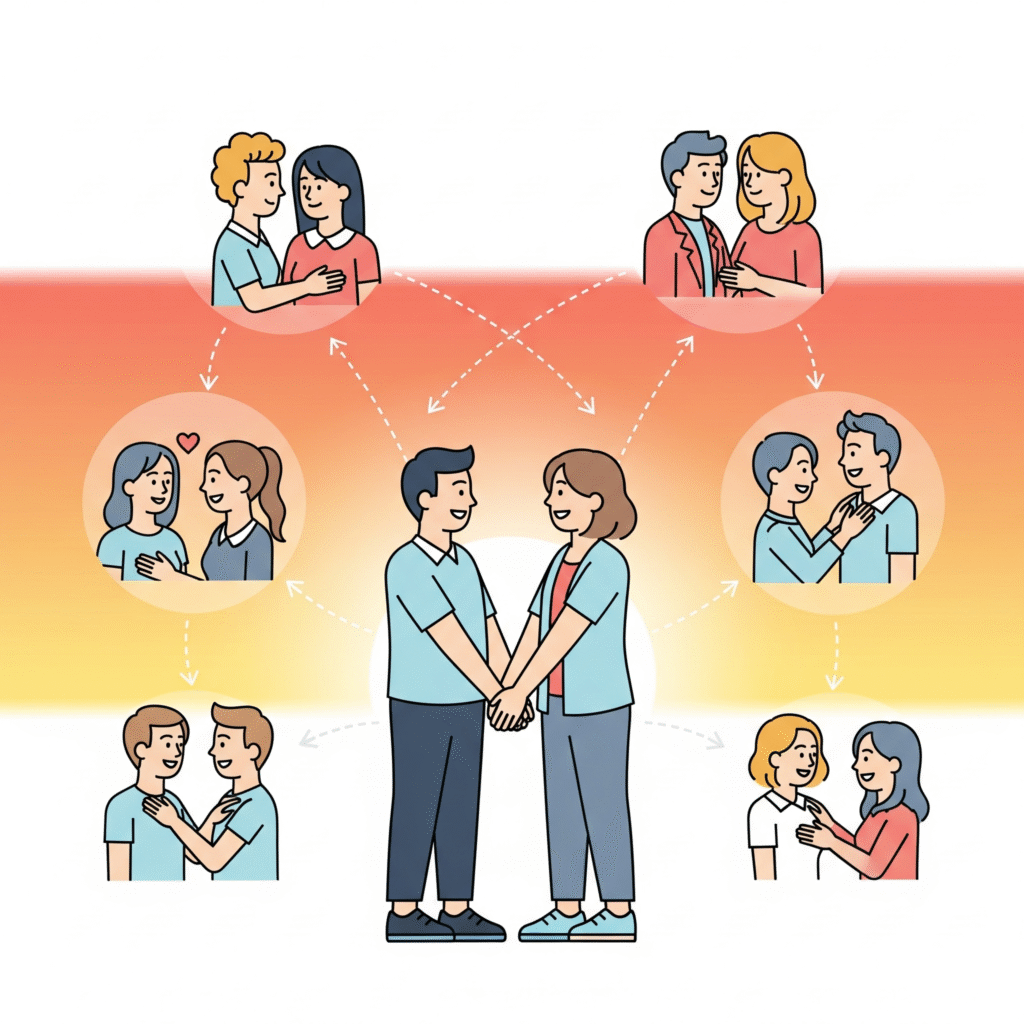

What is an open relationship? Learn how it works, common rules, boundaries, benefits, challenges and how to decide if consensual non-monogamy is right for you in 2026.
What Is an Open Relationship? 🤔
Love doesn’t come with one instruction manual.
Some couples want complete exclusivity, while others decide that a different relationship structure better matches their needs, values or expectations. One of those structures is an open relationship.
But before you hear “open” and assume anything goes, hold up. 😂
An open relationship is generally a consensually non-monogamous relationship where partners agree that one or both people may have romantic or sexual connections outside the primary relationship. The important part is consent, honesty, and clearly understood boundaries.
That makes it very different from secretly seeing someone behind your partner’s back.
In this guide, we’re breaking down what an open relationship really means, how it can work, common rules, the potential benefits and challenges, and the questions worth asking before deciding whether this type of relationship fits your life.
And yes, there’s some real world perspective too.
My E-E-A-T Experience With This Topic 🗣️
Let’s keep it real.
I have never personally been in an open relationship.
So I’m not going to write this article pretending I’ve personally experienced every situation I’m discussing. Instead, I spent time talking with people who have actually experienced this relationship style and used their perspectives to better understand what happens beyond the internet discussions and TikTok debates. 😂
One thing that stood out from those conversations was how different each arrangement can be.
For one person, openness may mean dating other people casually. For another couple, it may involve sexual experiences but no romantic relationships. Someone else may place much stronger limits around who they can see, how often, and what information gets shared.
That is why this article doesn’t treat one version as the “correct” one.
The people I interviewed emphasized that communication, boundaries, honesty and checking in with each other can become extremely important when expectations are more complicated than a traditional relationship.
That firsthand input helped shape this guide, but I’m also being clear about the limit of my own experience. My goal is to give you useful information without pretending to have lived a story I haven’t lived.
How Does an Open Relationship Work? 🔓
There isn’t one universal formula.
For many couples, it starts with a conversation about what they want and what they are comfortable with. That conversation needs to go further than simply saying, “We’re open now.”
Open to what?
Dating? Kissing? Sex? Emotional connections? Dating apps? Overnight stays?
Those details matter because two people can use the same label while imagining completely different relationships.
A successful arrangement usually depends on creating expectations before outside connections become complicated. Couples may also revisit those expectations later because feelings, circumstances, and comfort levels can change.
If communication is already difficult in your relationship, my guide on 15 Tiny Habits That Instantly Improve Communication in Relationships can give you practical ideas for improving those conversations.
Open Relationship vs. Polyamory ❤️
These terms are related, but they are not automatically the same thing.
An open relationship often refers to a primary partnership that allows some form of outside romantic or sexual connection.
Polyamory generally involves the possibility of multiple romantic relationships with the knowledge and consent of everyone involved.
Both can fall under the broader idea of consensual non-monogamy.
The label matters less than the actual agreement. Two couples can both describe themselves as being “open” while having completely different expectations.
That is why a conversation about boundaries is more useful than relying on a label alone.
Common Types of Open Relationships 🧩
Because every couple can create different boundaries, there are several ways an arrangement might look.
Casual outside dating allows partners to date other people without necessarily creating additional serious relationships.
Sexually open relationships may allow sexual experiences outside the primary partnership while keeping emotional exclusivity.
Open dating can involve going on dates and developing connections with other people, depending on what the couple has agreed upon.
Swinging usually refers to couples participating together in sexual experiences with others and is often treated as its own category.
There can be overlap between these structures, which is another reason clear communication matters.
Open Relationship Rules and Boundaries 📜
Rules aren’t there to kill the romance. They’re there so nobody has to play detective at 2 a.m. 😂
A healthy agreement should answer the questions that could otherwise create confusion later.
| Area | Questions to Discuss |
|---|---|
| Dating | Are dates with other people allowed? |
| Sex | What kinds of physical intimacy are okay? |
| Emotions | Are romantic feelings or serious relationships allowed? |
| Time | How much time can be spent with other people? |
| Privacy | What details should partners share? |
| Communication | When should a partner be informed? |
| Sexual health | What testing and protection agreements apply? |
| People | Are friends, coworkers or exes off-limits? |
The goal isn’t to create a giant legal contract for your love life. 😂
The goal is clarity. A boundary that only exists in one person’s head isn’t really a shared boundary.
The Do’s and Don’ts ✅❌
Do communicate before acting
Talk first, act second.
Making assumptions can create unnecessary conflict, especially when something that seems harmless to one person crosses an important line for the other.
Do make consent mutual
Both people should genuinely agree to the arrangement. Going along with something because you’re terrified of losing your partner isn’t the same as freely choosing it.
Do talk about sexual health
Safer sex needs to be part of the conversation. The CDC recommends prevention strategies such as testing and condom use to help reduce STI transmission. Learn more from the CDC’s STI prevention resources.
Do revisit the agreement
What worked three months ago may feel different later.
Regular check-ins make it easier to discuss changing emotions, new concerns, or boundaries that need to be adjusted.
Don’t use it to repair cheating
Opening the relationship is not a shortcut for fixing broken trust.
If there has already been dishonesty or betrayal, adding more complexity may create even more difficult conversations.
Don’t pressure your partner
“No” is a complete answer.
A partner should never feel forced into non-monogamy just to keep the relationship alive.
Don’t assume jealousy means failure
Jealousy can happen in any relationship structure.
Instead of immediately treating the emotion as proof that something is doomed, use it as a reason to slow down and talk about what is underneath it.
Don’t hide broken agreements
If a boundary was crossed, honesty matters. Pretending nothing happened usually doesn’t make the problem disappear.
Potential Benefits of an Open Relationship 🌟
There can be potential benefits for people who genuinely feel comfortable with consensual non-monogamy.
Some couples may appreciate having more freedom to explore attraction while keeping honesty at the center of the relationship. Others may value the opportunity to discuss desires and boundaries more openly than they previously did.
For some people, the structure can also encourage conversations they might otherwise avoid.
However, none of these benefits are automatic.
An open relationship isn’t automatically healthier or happier than monogamy. The success of any relationship depends on the people involved, the agreements they make, and how respectfully they handle each other’s needs.
Challenges You Should Think About ⚠️
More freedom can also mean more complexity.
Jealousy can become difficult when one partner forms a strong connection with someone else. Time can become another challenge because relationships require attention, communication, and emotional energy.
There can also be uneven experiences. One person may receive more attention or have more opportunities to date, which can create insecurity even when the original agreement was mutual.
Then there is the emotional side.
Imagine agreeing that outside dating is okay, only to discover that your partner has developed serious feelings for someone. That’s when a simple conversation can suddenly feel like the season finale of a relationship drama series. 😭
This is why emotional boundaries deserve just as much attention as physical ones.
If you’re trying to understand what healthy boundaries look like more generally, you can also read my guide on How to Build a Healthy Relationship That Lasts: 10 Proven Tips for Couples.
How to Know If This Relationship Style Is Right for You 🧠
There isn’t a quiz that can magically give you the answer.
Instead, think honestly about what you want.
Ask yourself:
Would I choose this freely?
Or am I agreeing because I am afraid my partner will leave?
Can I handle uncomfortable conversations?
Avoiding difficult emotions won’t make them disappear.
How do I feel about my partner dating someone else?
Don’t answer based on what sounds progressive or cool. Think about how you would realistically feel.
Can I respect boundaries when emotions get intense?
Am I comfortable with uncertainty and change?
Do I want this relationship structure, or do I simply want permission to fix a problem we already have?
Those questions can tell you much more than a social media poll ever could.
You can also explore my article on Healthy vs Toxic Love Explained Simply if you’re trying to understand whether your current relationship has a healthy foundation before making major changes.
What If One Partner Wants It and the Other Doesn’t? 💭
This is where things can get complicated.
You can’t negotiate genuine consent out of someone.
If one partner wants an open relationship and the other strongly prefers monogamy, pretending the disagreement doesn’t exist won’t solve it. Both people need the freedom to explain what they want and why.
Sometimes couples discover they can find a compromise. Other times, they realize their relationship expectations are fundamentally different.
Neither outcome is something to rush.
The key is making sure neither person is being manipulated, threatened or pressured into changing a core boundary.
My Biggest Takeaway From the People I Interviewed 👀
After speaking with people who have lived this kind of relationship, one thing became especially clear to me: “open” does not mean “no rules.”
Actually, the opposite can be true.
The more complicated the relationship arrangement becomes, the more important it can be to know what everyone understands and expects.
The interviews also reminded me that people can experience the same relationship structure in completely different ways. One person’s ideal setup could be another person’s absolute nightmare.
That’s why I’m not here to tell you whether you should choose this lifestyle. I’m here to help you understand what the choice actually involves. And honestly, that’s much better than copying something you saw in a 30-second TikTok. 😂
Frequently Asked Questions About Open Relationships ❓
Is an open relationship cheating?
Not inherently. When everyone involved knows about the arrangement and agrees to it, it is different from secret cheating. Breaking mutually agreed boundaries can still create betrayal and trust problems.
Can married couples have an open relationship?
Yes. A marriage can have different relationship structures as long as the people involved openly agree on what their boundaries are.
Can an open relationship become serious with other people?
It can, depending on the agreement. Some couples allow only casual connections, while others allow deeper emotional or romantic relationships.
Is an open relationship the same as polyamory?
No. There can be overlap, but polyamory generally involves multiple romantic relationships, while an open relationship often refers to a primary partnership with some agreed outside connections.
Do open relationships have rules?
Yes. The rules are usually created by the people involved and can cover dating, sex, emotional boundaries, time, privacy, safer sex, and communication.
Can couples stop being open?
Yes, couples can revisit and renegotiate their relationship structure. Any major change should be discussed honestly by both partners.
Conclusion ❤️
An open relationship isn’t simply about having permission to date other people.
It’s about communication, consent, honesty, boundaries, emotional responsibility, and being willing to have conversations that might not always be comfortable.
For some people, consensual non-monogamy may fit their values and expectations. For others, monogamy may feel much more natural and secure.
Neither choice needs a sales pitch.
What matters is understanding what you’re agreeing to and making sure everyone involved has a real voice in the decision.
I have never personally been in one, and I’m glad to be honest about that. The information in this article was shaped by research and conversations with people who have firsthand experience, rather than me pretending to be the main character in a story I haven’t lived. 😂
For another perspective, check out Verywell Mind’s guide to open relationships.
And when you’re ready for more relationship conversations, check out 12 Green Flags to Look for in the First 3 Months of Dating and the rest of the relationship advice here on Relationship with Murf. ❤️
💬 Your Turn
Could you see yourself trying this type of relationship, or would you rather keep things fully exclusive?
Drop your thoughts in the comments, share this article with someone who has been curious about the topic, and keep the conversation going.
💖 Support the Blog
If this post helped you learn something new, you can support my work with a small donation. And if donating isn’t possible, no worries — sharing the post is free! 😂❤️
Every share helps Relationship with Murf reach more people looking for honest, practical relationship advice.
Thanks for reading!
Signing off — where laughter, love & random deep convos never end.
Catch you in the next one! 😉❤️



Hey! I could have sworn I’ve been to this
blog before but after checking through soe of the post I realized
it’s neww to me. Anyhow, I’m definitely happy I found it
and I’ll be book-marking and checking back often!
It’s great to hear that you’ve been enjoying the blog! I’m glad you found it and that you’ll be bookmarking it. Thanks for your kind words and for checking back often. I’m always happy to have readers like you.
You can visit the blog here: relationshipwithmurf.comb
I’ve been surfing online more than 3 hours as of late, but I by no means found any attention-grabbing article like yours. It¦s pretty value enough for me. In my opinion, if all webmasters and bloggers made just right content as you did, the net shall be much more useful than ever before.
Thank you so much for the kind words! I’m really glad you found the article on Open Relationships valuable. My goal with the blog is to provide content that truly helps people navigate their love lives, so hearing this makes the work worth it. Stay tuned for more!